Unequal Yoking

I believe the third reason for the high divorce rate, even among Christian marriages is unequal yoking.

If one were to ask questions regarding compatibility in marriage, the usual responses may involve political affiliations, values, careers or how many kids a person may want have. And sometimes, unfortunately, no thought at all is given to any matters regarding compatibility. Faith issues seem to be less of a concern according to most research, especially right before marriage. To enter into a marriage relationship based on the afore mentioned items however, is not building a solid ground for a long lasting, successful partnership.

Even when religious affiliation is considered, differences don’t always detract wedding bells from being heard. In fact, interfaith marriages have been on the rise. According to this NPR broadcast stating that 20% of marriages in US in the 50’s were interfaith and this figure climbed to 45% by the first decade of the 21st century. In the same broadcast, it was mentioned that discussing family values and how to raise children within a world view was important but because society has become more focused on individual satisfaction, these concerns have taken a back seat. This lack of discussion leads to problems.

Looking at this topic from a Christian worldview, there is one primary factor that should be taken into account prior to marriage: whether your future spouse is also a Christian. The Bible describes this as being “equally yoked.” Paul wrote about this in 2 Corinthians 6:14-15, where he warns against being unequally yoked, “Do not be unequally yoked with unbelievers. For what partnership has righteousness with lawlessness? Or what fellowship has light with darkness? What accord has Christ with the Belial? What portion does a believer share with an unbeliever?”

To put this term yoked in the perspective of an agrarian society which is the kind of society in which the Bible was written, a farmer would yoke two oxen of similar size for plowing. This way they could both carry a load equally and efficiently, without one working harder than the other. Imagine for a moment if an ox were yoked with one of my yorkies. How much would Roxy (our yorkie’s name) contribute? Probably close to 0%!! Well, applying this illustration to a marriage, an unequally yoked couple will have different morals, values, priorities and friends. These differences can create significant problems as each person in the marriage tries to “plow” through life.

This is not a New Testament concept. It has always been God’s heart to give us joy through this parameter. In Deuteronomy 7:3-4, as God led the Israelites into the promised land, He gave them commands about unions:
“Do not intermarry with them. Do not give your daughters to their sons or take their daughters for your sons, for they will turn your sons away from following me to serve other gods, and the Lord’s anger will burn against you and will quickly destroy you.” God’s command was not to stifle or harm His people but to protect them and us.

As a married couple plows together through life, “life happens.” Job changes, financial difficulties, family difficulties, sickness, etc. People with different mindsets, values, beliefs, and priorities can have a difficult time navigating together through this maze of problems. The tendency may be to pull in different directions. It is no wonder why a survey by the American Religious Identification Survey of 2001, found that people of mixed religion marriages were 3 times more likely to be divorced than couples of the same religion. Why? I would venture to say that since Christ is not in the center, The foundation is weak and able to break. However, when Christ is at the center of a marriage two can truly become “won” and be able to withstand the pressures and challenges of life. God’s word relates this truth in Ecclesiastes 4:12, “Though one may be overpowered, two can defend themselves. A cord of three strands is not easily broken.”

So am I suggesting that is marriage a cake walk as long as Christ is in the center? Absolutely not!! Even with Christ at the center of a marriage, two imperfect people can have difficulty working through life’s obstacles. But when a marriage has been built on solid ground, on the “cornerstone that the builders rejected,” there’s a much higher chance that life’s challenges will be “won.”

So what if one finds themselves in an unequally yoked marriage? What’s the solution? I’ll touch on that in my next post.

COUNTING THE COST

IMG_2193.JPG
I’d like to get into the second reason I believe that lead to divorce. I have termed this, “Not Counting the Cost.” Any big decision takes thought, consideration, counsel and prayer. This is true for choosing careers, planning a career change, moving or planning a trip. Think of the last vacation you planned. Didn’t you think about dates, coordinate potential dates with work obligations, and how you being out of town would affect those around you?

We spend so much time and effort planning a vacation and a career but our society as a whole spends less time considering the important decision of a marriage. A decision that makes two people united; two people “won”, a decision that has implications for the rest of our lives, a decision that affects all other decisions afterwards, is made with less thought and consideration than choosing what pair of shoes one should buy.

Don’t believe me? Ok, after I said “I do,” decisions of what I was doing after work, on the weekends, or where we should move were made not by me alone but by discussion of two who became “won.” Why? My spouse became part of my flesh and my body part of hers. What happens to my kidneys will ultimately affect other body systems. A marriage is no different. We are now interdependent.

With the backdrop of how two independent bodies start functioning as one, we can now look at how ignoring this can lead to system failure. Imagine for a minute an athlete training for a team fitness event such as a doubles tennis tournament, a team crossfit competition or a soccer tournament. Although these are very different events, if the athlete preparing for his/her respective event ignores proper nutrition, his/her body will struggle. If hydration several days before the event is lacking, performance during the event will suffer. In short, if person training for these events does not consider the amount of training required, the proper amount of rest, the sacrifice that is needed to excel and compete against other elite athletes, he/she will come up short, get injured or exhibit system failure. In other words, not counting the cost of what preparation it takes to perform well will obviously affect the team’s ability to excel.

The same can be said of a marriage where failure to consider the give and take, the sacrifice, and the team work it takes for two to become “won,” will severely affect the effectiveness of the union. Although not a passage about marriage, in Luke 14, Jesus talked about the cost of becoming a disciple, which can have an application for considering the cost of a marriage. In verse 28-30, Luke wrote, “For which of you, intending to build a tower, does not sit down first and count the cost, whether he has enough to finish it lest, after he has laid the foundation, and is not able to finish, all who see it begin to mock him, saying, ‘This man began to build and was not able to finish’?”

Likewise, ladies and gentleman, if we don’t sit down and count the cost of what it means to sacrifice, what it means to love, what it means to become “won”, there will be a shaky foundation which will be difficult to last the tests of a marriage.

Not Only a Father but Also a Dad…

I could not ignore this day, special to many, and to me, without adding a post. I will post the continuation if my last post, but I felt compelled to post some thoughts about what it truly means to be a father. I post this not as an expert on the subject nor as the model of an ideal father, but as man who has learned from disappointments, other men, God’s word and experience on what it means to be a not only a father, but a dad.

No child should have to experience the absence of dad for months. No child should have to see his or her mother cursed at or physically beat. But unfortunately these are the most vivid memories I have on this Father’s Day. And that’s because I may have had a father but never a dad! I harbor no hatred since I did have the opportunity to forgive my father for his lack of commitment and loyalty, but the feelings still linger.

My biological father (I can’t bring myself to refer to him as dad) was hardly around. My younger brother didn’t meet him until he was 7! When he was present, he was more interested in being disengaged and not being a leader. He was more interested in arguing than loving. In fact, I don’t think I ever realized until just now that I never heard the words “I love you,” from my father. Not a great way to model fatherhood. But then again, even if he had said it, they would have been empty words with no actions behind them. He was much more interested in providing an example that if you don’t get your way in a marital argument you resort to the cowardly act of physically abuse.

So you see, although I had a man man who who participated in the act of making a baby with my mom, a biological father, my brothers and I never had a dad. And although we had some other family men, like my grandfather, who stepped up to the task, that void was still noticeable.

A dad, unlike a “baby daddy,” to borrow a term from the common vernacular, will not only make a baby but will provide an example for his baby and kids. The example that a dad should look to pass on has to do with how to lead in Godly love, how to love his wife, how to love his children and how set a standard of what a man is for his daughters. The desire that a dad has to provide a positive influence for his child comes from his love not only for the child but primarily out of the love he has for his wife.

You see, in God’s word and in His standard, a man must first be a husband in order to be a father, 1 Corinthians 7:2-4. This is in line with the rest of scripture which labels sex outside of marriage as a sin, as referenced in 1 Thessalonians 4:3-7,
“For this is the will of God, your sanctification: that you abstain from sexual immorality; that each one of you know how to control his own body in holiness and honor, not in the passion of lust like the Gentiles who do not know God; that no one transgress and wrong his brother in this matter, because the Lord is an avenger in all these things, as we told you beforehand and solemnly warned you. For God has not called us for impurity, but in holiness.”

Therefore, being a responsible father must follow from being a good husband. This is called commitment. The husband must love, honor, nourish and cherish his wife in every aspect of her life as we read in Ephesians 5:25-30 and 1 Peter 3:7. Only then will one be prepared to be a good father. For only in this manner will a boy have modeled how a true husband should treat a woman and a girl have a standard from which she can judge all men.

So a man who is a father and wants to be a dad must first provide a positive influence of loving his wife in a manner that glorifies God. The second part of of being a dad is directly related to the children and is a direct mandate from Paul in Ephesians 6:4; “And you, fathers, do not provoke your children to wrath, but bring them up in the training and admonition of the Lord.” What does provoking a child to wrath have to do with modeling or loving my wife? Well, as a dad I should not do things that make my children angry, resentful or bitter. In other words, I should love my wife not scorn her, I should protect and care for my wife not beat her, I should be loyal to my wife not engage in extramarital affairs, and I should provide for my children not neglect them.

Well these are my thoughts on this Father’s Day. I have been given a true blessing in my kids but also an immense responsibility. I pray that I will always be faithful in spite of my past. Happy Father’s Day!!

What Does “I Do” Mean?


I said "I do" and I still do.

I said “I do” and I still do.

These two words which mark the signature on a binding contract seem to have lost their meaning over so many years.  According to the American Psychological Association about 40 to 50 percent of married couples in the United States divorce. The divorce rate for subsequent marriages is even higher. This being the case, one must wonder if these two words have lost their meaning over time.  Or are they truly being spoken from the heart.

How can the promises that are made between two people as they face each other and later confirmed with, “I do,” lose their strength over time?   How can the commitment behind these two words diminish over time?   How can the love that two people profess to each other simply vanish in thin air?  These are questions that I have asked myself regarding half of the marriages in my family, including my mother and father’s.

Well, as I pondered on this topic, even before I said “I do,” I still never understood why a man, like my father, would dare to make a such an important, lasting commitment if he did not want to be loyal and monogamous.  How could he leave three teenagers behind and establish another family.  I understand that not all situations are the same, but as for my parent’s marriage, the main issue was a lack of leadership and commitment. My father was not the head of the house and never commanded respect from his sons.  He also was not loyal and had no commitment to his own promises – “I do.”  My mother had her own set of issues and broken promises but none of these warranted infidelity.  Of course, after this, trust went out the window.  They had never had laid a foundation for effective communication or the help of the Counselor, so getting over such a tragic situation was virtually impossible.  He then looked elsewhere and left home for another woman.

Those two words, I do, uttered several years before became a punch line.  They became a bed of resentment, anger and lies.  The commitment to “won” became a preoccupation with self.  “What makes me happy,” “How can I have what I want,” “I want, I need.”  “I” becomes the focus instead of “you” or “we.”

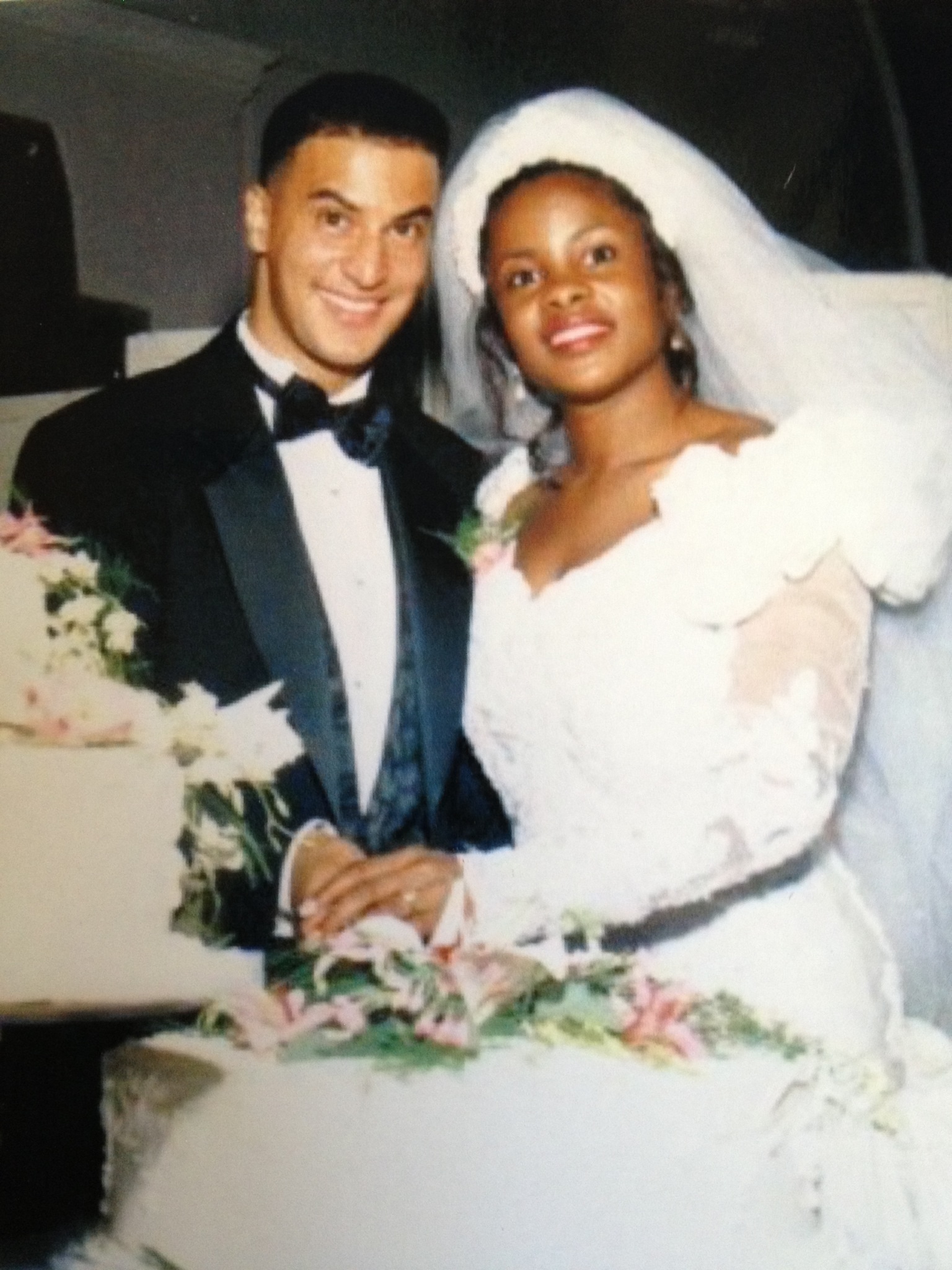
I share this story not as a form of catharsis, since I have made peace with my own demons of anger that plagued me as a result of a man not fulfilling his part of a sacred and solemn vow, but as a backdrop to what “I do” should mean.  You see, when I looked into the eyes of my beautiful bride and we exchanged vows, I made a promise first to God and then to my bride that I would love and cherish her, always protect her, work through any arguments, be a servant leader, always respect her, and never leave her.  I also made a promise to treat love as a verb and not a noun.  In other words, I made a commitment to fight for my marriage.

And this is what “I do” means to me. It’s a commitment, a promise before God and bride that two will ALWAYS be “won.”  It means that no there are no obstacles that can’t be overcome.  It means that I commit to making this union work.  Not out of compulsion but out of love.  It means that I and my wife will work on our shortcomings to make our “won” functional.  It DOES NOT mean that it’s easy.  But it does that “It’s worth having and saving.”

Marriage and sacrifice….can’t have one without the other

Everything that is worth having is worth working for.  This old adage couldn’t be any truer than in the marriage relationship.  In the context of marriage this “working for” can be labeled as sacrifice. Sacrifice has a bad connotation in our society when it comes to relationships because we are told to always look out for number one. But we admire those who sacrifice of themselves for others in other contexts- military, physicians, firefighters, etc. 

When you sacrifice for someone, you show them love.  And love is more of a verb than an emotion and therefore requires action. Love as a feeling is conditional and dependent on our mood or our feelings.  True love however, should cause you act in tangible ways for the one you love.  We think of our spouse’s well being first. True love requires sacrifice. 

Men, by nature are explorers, conquerors, and protectors.   The first two characteristics serve well in the context of dating.  But when a commitment is made, when two truly become “won”, the role of protector should take over.   As such, sacrificing of ourselves for our wives should come as a natural extension of who we are.  When we sacrifice of ourselves for our wives, it communicates that they are important, that we care about them and we want wants what’s best for them.  Sacrificing of ourselves more importantly puts us second.  This is not only sacrifice, but it’s the basis of servant leadership.  

 What does sacrifice look like in the context of marriage you ask?  Great question!  Well, I can say I would watch “The Notebook” with my wife if she wanted me to instead of the Super bowl but I would be lying! Just kidding.  But really, there would be no way I could do that.

True sacrifice in marriage means that I would be willing to do whatever is needed for my spouse’s well being.  That means I will be cancelling a planned golfing weekend to be with my wife after a stressful week.  This means that I will leave work early to pick up and stay with the kids if she needs time with her friends.  This means that I will wash dishes after she has cooked.  And it definitely means that I will help her onto a boat if I sense danger in the water while snorkeling. … Well actually this is one area that I failed since I did the exact opposite when confronted with the same situation during our honeymoon.  But to my defense, it was my first time snorkeling.  Ha!

The real take home point here is that when we sacrifice for our loved ones we are really sacrificing for ourselves because in marriage two become “won.”

We don’t feed the Machine

Roses

We don’t Feed the Machine

So what are you getting your wife for Valentines Day? Are you getting your wife flowers? Every year these questions are asked of me by some women at the work. There is such an expectation to hear some great, elaborate story that it almost seems like a chance to live vicariously through a romantic tale. The irony of it all is that usually these questions are asked by ladies who openly complain of their married lives and how much their husbands don’t do. The interviewers are almost dumfounded when they hear my response: “We don’t feed the machine.”

I understand about doing something special for the one you love, which sweeps her off her feet all over again. But why should this be relegated to one day of the year that dates back to the 5th century? Why should the expectation of treating the one you love, the one with whom you became “won” be for only 1 out of 365 days?

Well, before I get labeled as a curmudgeon, I will say that I like to do special things for the love of my life. I like to be spontaneous, romantic and do things that just make my wife feel as if she were a newlywed. But I enjoy doing these things throughout the year instead of one day where society has created an expectation that a husband’s love is to be proved with flowers, chocolate and cards. The only spontaneous, romantic thing I cannot do is breakfast in bed. Why you ask. Unfortunately I cannot cook. : (

However, I like to clean after my wife cooks. I like to vacuum, sweep and mop the floor. What I like even more is to hear my wife say, “Thank you honey,” after I do these things. Not that she needs to say this but to know that I did something special for my beautiful wife is GREAT! To see the look of relief on my love’s face as if she were to say, “I am so glad I don’t have to do that after I’ve just done…,” is so satisfying that if makes me want to do it again. Why? Because I love her and she deserves it. You see, the Bible is clear on how I should treat my wife: with respect and in a way that protects her. In fact, in 1 Peter 3:7, Peter states that if we neglect this, a husband’s prayer will not be answered.  This refers to how a husband treats his wife on a daily basis.  Not on special occasions.

By telling my wife that I love her throughout the year, two can truly become “won.” This is not necessarily done with words, although saying “I love you” everyday is important, but with actions. This is especially true since love is a verb not a feeling. If this is practiced often it is easy to continue. It takes a lot more inertia to do this once a year. Just sayin’…. Happy Valentine’s Day!!

Sacrifice in marriage…a requirement for success

BlogPicSacrifice

Everything that is worth having is worth working for. This old adage couldn’t be any truer than in the marriage relationship. In the context of marriage this “working for” can be labeled as sacrifice. Sacrifice has a bad connotation in our society when it comes to relationships because we are told to always look out for number one. But we admire those who sacrifice of themselves for others in other contexts- military, physicians, firefighters, etc.

When you sacrifice for someone, you show them love. And love is more of a verb than an emotion and therefore requires action. Love as a feeling is conditional and dependent on our mood or our feelings. True love however, should cause you act in tangible ways for the one you love. We think of our spouse’s well being first. True love requires sacrifice.

Men, by nature are explorers, conquerors, and protectors. The first two characteristics serve well in the context of dating. But when a commitment is made, when two truly become “won”, the role of protector should take over. As such, sacrificing of ourselves for our wives should come as a natural extension of who we are. When we sacrifice of ourselves for our wives, it communicates that they are important, that we care about them and we want what’s best for them. Sacrificing of ourselves more importantly puts us second. This is not only sacrifice, but it’s the basis of servant leadership.

What does sacrifice look like in the context of marriage you ask? Great question! Well, I can say I would watch “The Notebook” with my wife if she wanted me to instead of the World Cup but I would be lying! Just kidding. But really, there would be no way I could do that. That would be a disgrace to my Brazilian heritage! Ok, just kidding again. I think…

True sacrifice in marriage means that I would be willing to do whatever is needed for my spouse’s well being. That means I will be cancelling a planned golfing weekend to be with my wife after a stressful week. This means that I will leave work early to pick up and stay with the kids if she needs time with her friends. This means that I will wash dishes after she has cooked. And it definitely means that I will help her onto a boat if I sense danger in the water while snorkeling. … Well actually this is one area that I failed since I did the exact opposite when confronted with the same situation during our honeymoon. But to my defense, it was my first time snorkeling. Ha!

The real take home point here is that when we sacrifice for our loved ones we are really sacrificing for ourselves because in marriage two become “won.”